-
Prep Time: 20 minutes
-
Bake Time: 55–65 minutes
-
Cooling Time: 45 minutes
-
Total Time: Approximately 2 hours 10 minutes
-
Yield: 1 large loaf (serves 8 to 10 beautifully generous slices)
Essential Equipment
-
A standard $8.5 \times 4.5$-inch or $9 \times 5$-inch metal loaf pan
-
A microplane grater or citrus zester
-
A citrus juicer
-
Two mixing bowls (one large, one medium)
-
A sturdy wire whisk and silicone spatula
-
Unbleached parchment paper
-
A wire cooling rack
Ingredients
The Lemon Loaf Batter
-
1½ cups all-purpose flour (spooned and leveled to prevent a dense bake)
-
1 teaspoon baking powder
-
½ teaspoon fine sea salt
-
1 cup granulated sugar
-
2 tablespoons freshly grated lemon zest (from approximately 2 large, vibrant organic lemons)
-
½ cup unsalted butter, melted and cooled slightly (or sub premium avocado oil for an even moister crumb)
-
3 large eggs, room temperature (essential for proper emulsification)
-
½ cup plain Greek yogurt or full-fat sour cream (the secret ingredient for an ultra-moist interior)
-
2 tablespoons fresh lemon juice
-
1 teaspoon pure vanilla extract
-
1½ cups fresh blueberries (washed, dried thoroughly, and tossed with 1 tablespoon of extra flour)
The Tart Lemon Glaze
-
1 cup powdered sugar (confectioners’ sugar, sifted to remove clumps)
-
2 to 3 tablespoons fresh lemon juice (adjusted to achieve your preferred thick-yet-pourable drizzle)
-
Optional: A splash of heavy cream for an opaque, milky-white glaze look
Step-by-Step Instructions
Step 1: Prep Your Oven and Pan
Preheat your oven to 350°F (175°C) with the oven rack positioned securely in the center. Lightly grease your loaf pan with butter or non-stick cooking spray. Line the pan with a sheet of parchment paper, leaving a slight overhang on the long sides. This creates a “sling” that allows you to easily lift the fully glazed cake out of the pan later without risking breakage.
Step 2: Massage the Citrus Zest
In a small dish, combine the 1 cup of granulated sugar and 2 tablespoons of freshly grated lemon zest. Using your fingertips, rub and massage the lemon zest directly into the sugar crystals for about 1 to 2 minutes. You will notice the sugar turn a pale yellow and become highly aromatic. This crucial step releases the natural citrus oils embedded in the zest, amplifying the lemon flavor far better than simply tossing it into a batter.
Step 3: Whisk the Dry and Wet Foundations
In a medium bowl, whisk together the 1½ cups of all-purpose flour, baking powder, and fine sea salt until uniform. In a separate large mixing bowl, vigorously whisk together the lemon-infused sugar, melted unsalted butter, room temperature eggs, sour cream (or Greek yogurt), fresh lemon juice, and vanilla extract until the mixture is completely smooth, pale, and emulsified.
Step 4: Fold the Batter with Gentle Intensity
Pour the dry flour mixture directly into the bowl with the wet ingredients. Switch to your silicone spatula. Using Low intensity, gently fold the ingredients together just until the flour streaks disappear. Stop mixing immediately once it is combined—over-mixing activates the gluten, which results in a tough, rubbery loaf rather than a tender cake.
In a small bowl, toss your clean, dry blueberries with 1 tablespoon of flour until coated. This flour coating acts as a barrier, preventing the heavy berries from sinking straight to the bottom of the loaf pan during baking. Gently fold the coated blueberries into the batter with two or three final turns of the spatula.
Step 5: Bake to Golden Perfection
Spoon the thick batter evenly into your prepared loaf pan, smoothing down the top surface with the back of your spatula. Place the pan in the oven and bake at 350°F (175°C) for 55 to 65 minutes.
The cake is ready when the top springs back lightly when pressed, the center ridge splits beautifully, and a wooden toothpick inserted deep into the center comes out clean or with just a few moist crumbs (no wet batter). If you notice the top browning too rapidly around the 40-minute mark, simply tent a loose sheet of aluminum foil over the pan for the remainder of the bake.
Step 6: Cool, Glaze, and Elevate
Remove the cake from the oven and allow it to rest inside the pan on a wire rack for 15 minutes. Use the parchment paper sling to lift the warm loaf safely from the pan, transferring it directly onto the wire cooling rack to cool completely.
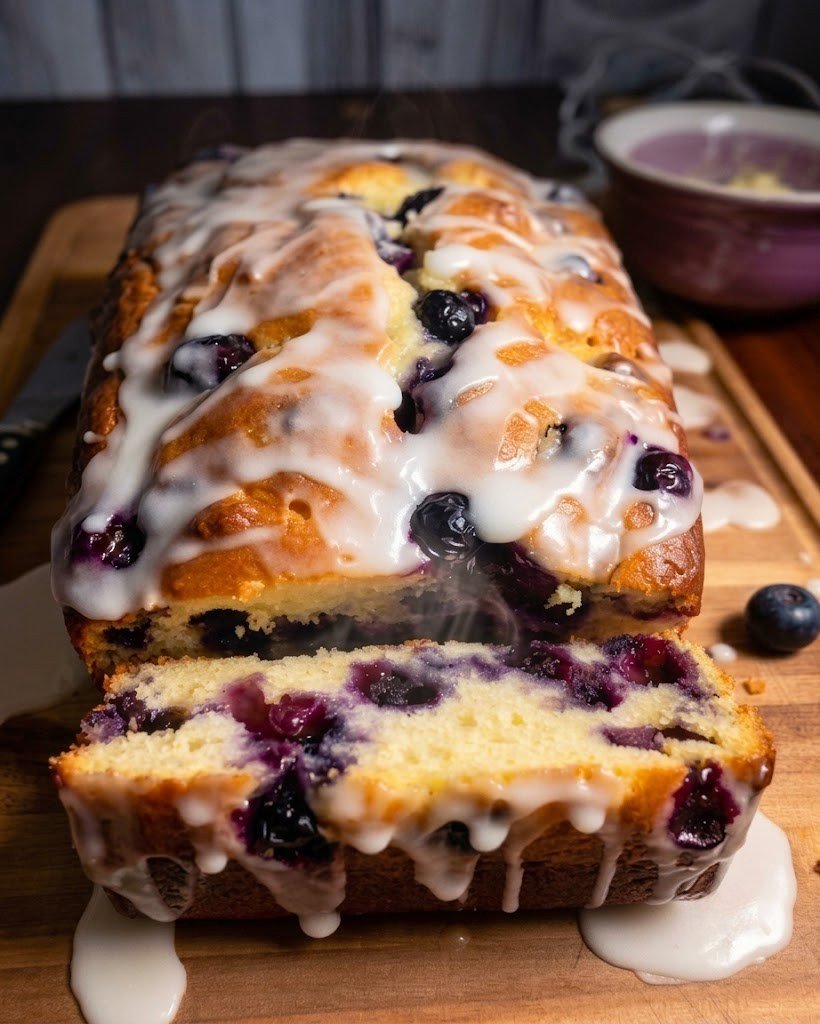
While the cake cools, whisk together the 1 cup of powdered sugar and 2 tablespoons of fresh lemon juice in a small bowl until a thick, glossy, ribbon-like glaze forms. Once the cake has reached room temperature, pour the glaze generously over the top ridge, allowing it to pool elegantly down the sides. Let the glaze set for 10 minutes before slicing into beautiful, thick pieces.
Storage and Reheating
-
Room Temperature: Store the glazed loaf in an airtight container or tightly wrapped in plastic film for up to 3 days on your kitchen counter. It stays incredibly moist!
-
Refrigerator: Keep wrapped in the fridge for up to 1 week. Bring slices back to room temperature for 15 minutes before serving to let the butter soften.
-
Freezing: You can freeze the unglazed loaf beautifully. Wrap the completely cooled cake tightly in plastic wrap, followed by a sturdy layer of aluminum foil. Freeze for up to 3 months. Thaw overnight in the refrigerator before glazing and serving.
Nutritional Estimation
The values provided below are calculated per individual slice, assuming the entire loaf cake is divided into 10 uniform slices.
-
Calories: 285 kcal
-
Total Carbohydrates: 46g
-
Dietary Fiber: 1.2g
-
Sugars: 31g
-
-
Protein: 4g
-
Total Fat: 10.5g
-
Saturated Fat: 6g
-
Trans Fat: 0g
-
-
Cholesterol: 75mg
-
Sodium: 140mg
-
Potassium: 95mg
-
Vitamin C: 12% DV
-
Calcium: 4% DV
-
Iron: 6% DV