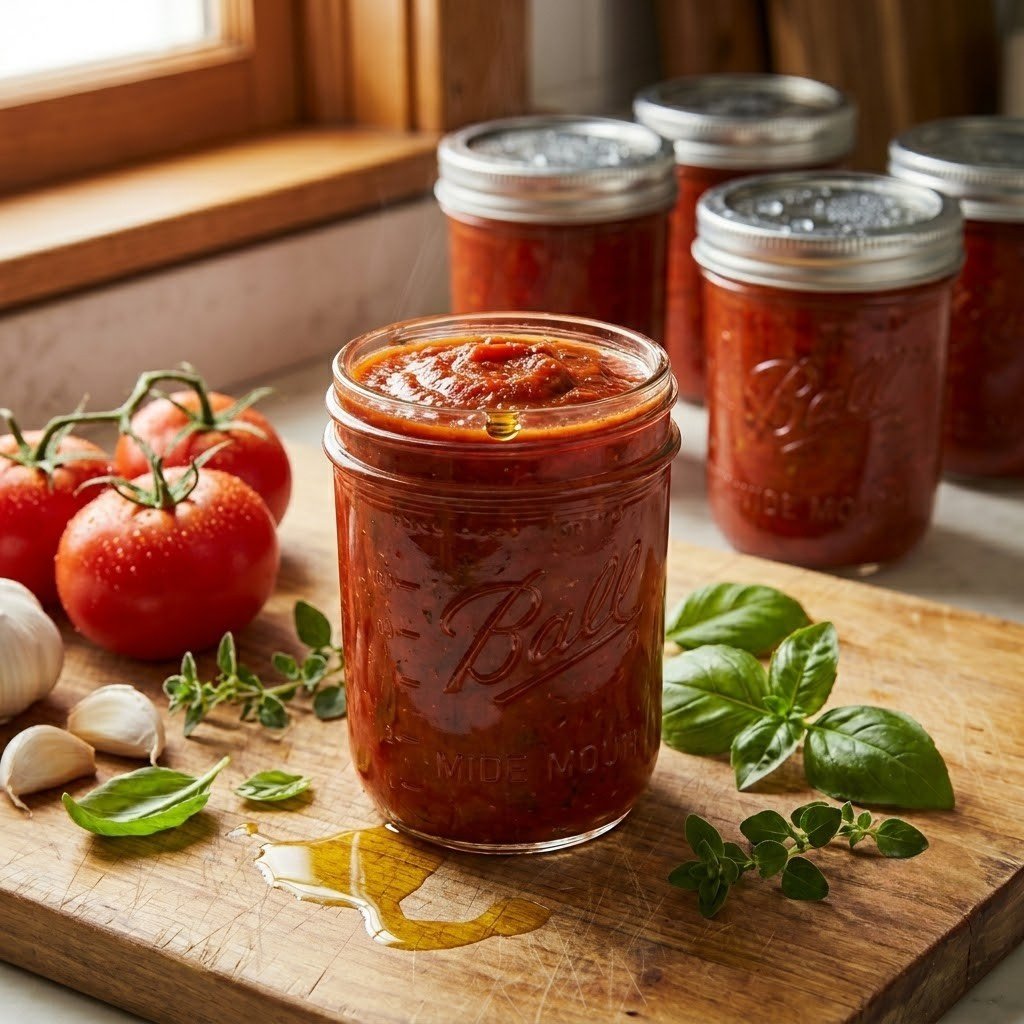
-
Prep Time: 15 minutes
-
Simmer Time: 45 minutes to 1 hour
-
Total Time: Approximately 1 hour and 15 minutes
-
Yield: Makes about 4 pints (8 cups / 2 quarts) of rich sauce
Essential Equipment
-
A large, heavy-bottomed Dutch oven or deep stockpot (5 to 6-quart capacity)
-
A sturdy wooden spoon or silicone spatula
-
A sharp chef’s knife and heavy wooden cutting board
-
An immersion blender (optional, depending on your preferred texture)
-
Sterilized glass mason jars with bands and lids (if canning for storage)
Ingredients
The Tomato Foundation
-
5 pounds fresh Roma or San Marzano tomatoes (blanched, peeled, and crushed) OR 4 cans (28 ounces each) of premium whole peeled San Marzano tomatoes
-
1 tablespoon tomato paste (double-concentrated, for building deep, caramelized umami color)
The Aromatic Base
-
½ cup premium extra-virgin olive oil (do not skimp; the oil acts as an emulsifier and flavor carrier)
-
1 medium yellow onion, finely diced
-
8 to 10 cloves fresh garlic, thinly sliced (slicing gives a mellower, sweeter garlic flavor than pressing)
-
1 teaspoon crushed red pepper flakes (optional, for a subtle, warming background heat)
The Herb & Finishing Profile
-
1 large bunch fresh sweet basil (leaves torn, stems kept intact for simmering)
-
3 to 4 sprigs fresh oregano (or 1 teaspoon dried oregano)
-
1 to 2 teaspoons fine sea salt (adjusted to taste)
-
½ teaspoon freshly cracked black pepper
-
Optional: 1 teaspoon granulated sugar (only if tomatoes are highly acidic; omit if using high-quality sweet winter or vine-ripened tomatoes)
Step-by-Step Instructions
Step 1: Prep the Tomatoes
If using fresh tomatoes, cut a small, shallow “X” on the bottom of each. Blanch them in boiling water for 30 to 60 seconds until the skins begin to split, then plunge them into an ice bath. The skins will slide right off. Coarsely chop the peeled tomatoes or crush them by hand into a bowl. If using canned San Marzano tomatoes, pour them into a large bowl and gently crush them with your hands or a potato masher to your desired level of chunkiness.
Step 2: Build the Aromatic Foundation
Place your heavy-bottomed Dutch oven over Medium-Low heat. Pour in the ½ cup of extra-virgin olive oil. Once the oil shimmers slightly but before it smokes, add the finely diced yellow onion. Cook for 6 to 8 minutes, stirring frequently, until the onions are soft, translucent, and sweet, but completely unbrowned.
Add the thinly sliced garlic and optional red pepper flakes. Reduce heat to Low intensity and cook for another 2 to 3 minutes. The garlic should become incredibly fragrant and soft without picking up any bitter, dark golden color.
Step 3: Caramelize the Paste
Increase the heat slightly back to Medium-Low. Clear a small space in the center of the pot and drop in the 1 tablespoon of tomato paste. Let it fry directly on the bottom of the pot for about 2 minutes, stirring continuously, until it darkens from a bright red to a deep brick color. This step cooks out the raw metallic taste of the paste and deepens the final sauce.
Step 4: Simmer and Infuse
Pour in the crushed tomatoes along with all their juices. Stir the pot thoroughly, scraping up any caramelized bits from the bottom. Toss in the whole basil stems (we will fish these out later) and fresh oregano sprigs. Season with 1 teaspoon of sea salt and the black pepper.
Bring the sauce up to a gentle boil, then immediately drop the heat down to Low intensity. You want a slow, lazy bubble—a heavy boil will scorch the bottom and evaporate the delicate aromatic top notes. Simmer uncovered for 45 to 60 minutes, stirring every 10 minutes. The sauce is ready when the oil separates slightly onto the surface and the volume has reduced by roughly one-third, leaving you with a thick, cohesive texture.
Step 5: Texture and Final Adjustments
Remove the pot from the heat. Use tongs to find and discard the woody basil stems and oregano sprigs. Stir in the freshly torn fresh basil leaves; the residual heat will wilt them and release their essential oils without boiling away their bright flavor. Taste the sauce. If it tastes too sharp or acidic, stir in the optional teaspoon of sugar. Add more sea salt to taste if needed.
-
For a Rustic Sauce: Leave it as is, beautifully chunky and textured.
-
For a Smooth Sauce: Use an immersion blender directly in the pot for 1 to 2 minutes until it reaches a velvety, restaurant-style consistency.
Storage and Preservation
-
Refrigerator: Let the sauce cool completely before transferring it to glass jars. Store it in the fridge for up to 5 days.
-
Freezer: Leave an inch of headspace at the top of freezer-safe containers or use heavy-duty freezer bags. The sauce freezes beautifully for up to 6 months.
-
Long-Term Canning: If canning, stir in 1 tablespoon of bottled lemon juice per pint jar to ensure proper acidity levels. Process the filled jars in a boiling water bath for 35 minutes to make them completely shelf-stable for up to 1 year.
Nutritional Estimation
The values provided below are calculated per standard serving (½ cup / 4 ounces) based on a traditional yields-of-8-cups formulation using standard canned whole peeled tomatoes and olive oil.
-
Calories: 95 kcal
-
Total Carbohydrates: 8g
-
Dietary Fiber: 2g
-
Sugars: 4.5g
-
-
Protein: 1.5g
-
Total Fat: 7g
-
Saturated Fat: 1g
-
Trans Fat: 0g
-
-
Cholesterol: 0mg
-
Sodium: 310mg
-
Potassium: 340mg
-
Calcium: 4% DV
-
Vitamin A: 12% DV
-
Vitamin C: 20% DV
-
Iron: 6% DV