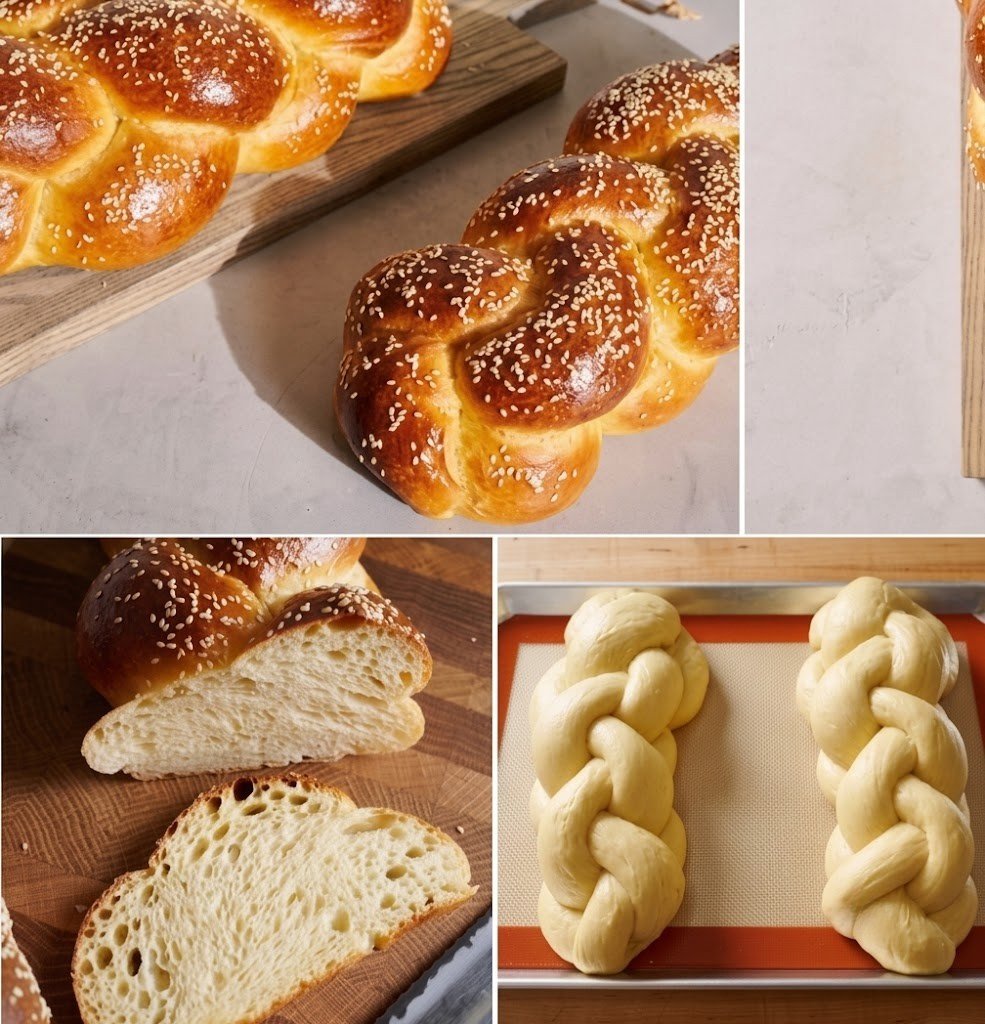
-
Prep Time: 25 minutes
-
Rise Time: 2 hours 30 minutes (divided)
-
Bake Time: 30 to 35 minutes
-
Total Time: Approx. 3 hours 30 minutes
-
Yield: 1 large braided loaf (approx. 12-14 servings)
| Stage | Duration | Attention & Effort Intensity | What to Look For |
| 1. Mixing & Activating | 10 mins | Low (Gentle whisking) | Yeast should become frothy and aromatic. |
| 2. Kneading | 10 mins | High (Active physical labor) | Dough transforms from shaggy to smooth and elastic. |
| 3. First Rise (Bulk) | 1.5 hours | None (Passive waiting) | Dough should fully double in size. |
| 4. Shaping & Braiding | 15 mins | Medium (Focus & precision) | Even strands braided snugly but not too tightly. |
| 5. Second Rise (Proof) | 1 hour | None (Passive waiting) | Loaf looks puffy; an indentation springs back slowly. |
| 6. Baking | 30-35 mins | Medium (Monitoring color) | Deep golden-brown crust with a hollow sound when tapped. |
Ingredients You Will Need
For the best results, measure your flour carefully using a digital kitchen scale if you have one, or use the “spoon and level” method with measuring cups.
For the Dough:
-
Active Dry Yeast: 1 package (2 ¼ teaspoons / 7 grams)
-
Warm Water: 1 cup (240ml), precisely between 105°F and 110°F
-
Granulated Sugar: 1/3 cup (65 grams), divided
-
Vegetable Oil: 1/3 cup (80ml), plus a little extra to grease the bowl
-
Large Eggs: 2 whole eggs + 1 egg yolk (reserve the extra white for the egg wash)
-
Fine Sea Salt: 2 teaspoons (10 grams)
-
Bread Flour: 4 to 4 ½ cups (500 to 560 grams), plus more for dusting
For the Topping & Glaze:
-
Egg Wash: 1 reserved egg white + 1 whole egg + 1 tablespoon water
-
Optional Seeds: 1-2 tablespoons of sesame seeds or poppy seeds
Step-by-Step Instructions
Step 1: Activate the Yeast
In a large mixing bowl (or the bowl of a stand mixer), combine the warm water, active dry yeast, and 1 tablespoon of the granulated sugar. Give it a gentle stir and let it sit undisturbed for 5 to 10 minutes.
The Yeast Check: Look for a thick layer of foam and small bubbles forming on the surface. If the water remains flat and clear, your yeast may be expired or the water was too hot. Stop here and restart with fresh yeast to ensure your bread rises perfectly.
Step 2: Mix the Wet Ingredients
Once the yeast is frothy, add the remaining granulated sugar, vegetable oil, 2 whole eggs, and 1 egg yolk into the bowl. Whisk vigorously until the eggs are completely broken down and the mixture is uniform.
Step 3: Incorporate the Flour & Knead
Add the salt and start adding the bread flour 1 cup at a time. Stir with a sturdy wooden spoon or a dough whisk until a shaggy, sticky dough begins to pull away from the sides of the bowl.
-
If kneading by hand: Turn the shaggy dough onto a lightly floured clean surface. Push the dough down and away from you with the heels of your hands, fold it back over itself, turn it 90 degrees, and repeat. Knead firmly for 8 to 10 minutes.
-
If using a stand mixer: Attach the dough hook and mix on low-medium speed for 5 to 7 minutes.
How to know it’s ready: The dough should feel incredibly smooth, slightly tacky (but not sticking to your fingers), and hold a neat ball shape. If you press a finger into the dough, it should spring back quickly.
Step 4: The First Rise
Shape the kneaded dough into a smooth ball. Lightly grease a large, clean bowl with a teaspoon of vegetable oil. Place the dough inside, turning it over once so the top is thinly coated in oil. Cover the bowl tightly with plastic wrap or a damp kitchen towel. Place it in a warm, draft-free spot for 1 hour and 30 minutes, or until it has noticeably doubled in size.
Step 5: Divide and Shape the Strands
Gently punch down the center of the risen dough to release the built-up air bubbles. Turn it onto a very lightly floured surface. Weigh the total dough and divide it into 3 or 4 equal portions using a bench scraper or a sharp knife.
Take one portion and flatten it into a rough rectangle. Roll it up tightly lengthwise like a jelly roll, then roll it back and forth under your palms to stretch it out into a smooth strand roughly 14 inches long. Repeat this process with the remaining portions, ensuring all strands are equal in length and thickness.
Step 6: Braid the Challah (Traditional 3-Strand)
Line a large baking sheet with parchment paper. Arrange your 3 strands side-by-side directly on the paper.
-
Gather the tops of the three strands together and pinch them firmly to seal, tucking the raw edge slightly underneath.
-
Take the strand on the far right and cross it over the center strand. The right strand is now your new center.
-
Take the strand on the far left and cross it over the new center strand.
-
Repeat this alternating pattern—right over center, left over center—keeping the braid snug but avoiding pulling or stretching the dough too tightly.
-
When you reach the end, pinch the tips tightly together and tuck them neatly underneath the loaf.
Step 7: The Second Rise & First Egg Wash
Gently brush the braided loaf with a thin, even layer of your prepared egg wash. Make sure to get into the crevices of the braid, but do not let it pool at the bottom. Save the rest of the egg wash in the refrigerator.
Leave the loaf uncovered and let it rise in a warm spot for 1 hour. The loaf should look beautifully plump, pillowy, and significantly expanded.
Step 8: Bake to Perfection
While the bread finishes its second rise, preheat your oven to 350°F (175°C) with a rack placed right in the center.
Just before sliding the loaf into the oven, brush it gently with a second layer of egg wash. This second coat fills in any gaps exposed during the final rise and creates that signature, deep lacquered look. Sprinkle generously with sesame or poppy seeds if desired.
Bake for 30 to 35 minutes. Keep an eye on it around the 20-minute mark; if the top is darkening too quickly, tent it loosely with a piece of aluminum foil for the remaining time. The Challah is done when the crust is a rich mahogany brown, and the bottom sounds hollow when gently tapped. Internal temperature should read between 190°F and 200°F on an instant-read thermometer.
Let the bread cool entirely on a wire rack before slicing.
Nutritional Information
The following values are estimated calculations per serving, based on a single loaf cut into 12 equal slices.
-
Calories: 245 kcal
-
Total Fat: 7.5g
-
Saturated Fat: 1.2g
-
-
Cholesterol: 48mg
-
Sodium: 410mg
-
Total Carbohydrates: 38g
-
Dietary Fiber: 1.5g
-
Sugars: 6g
-
-
Protein: 6.5g