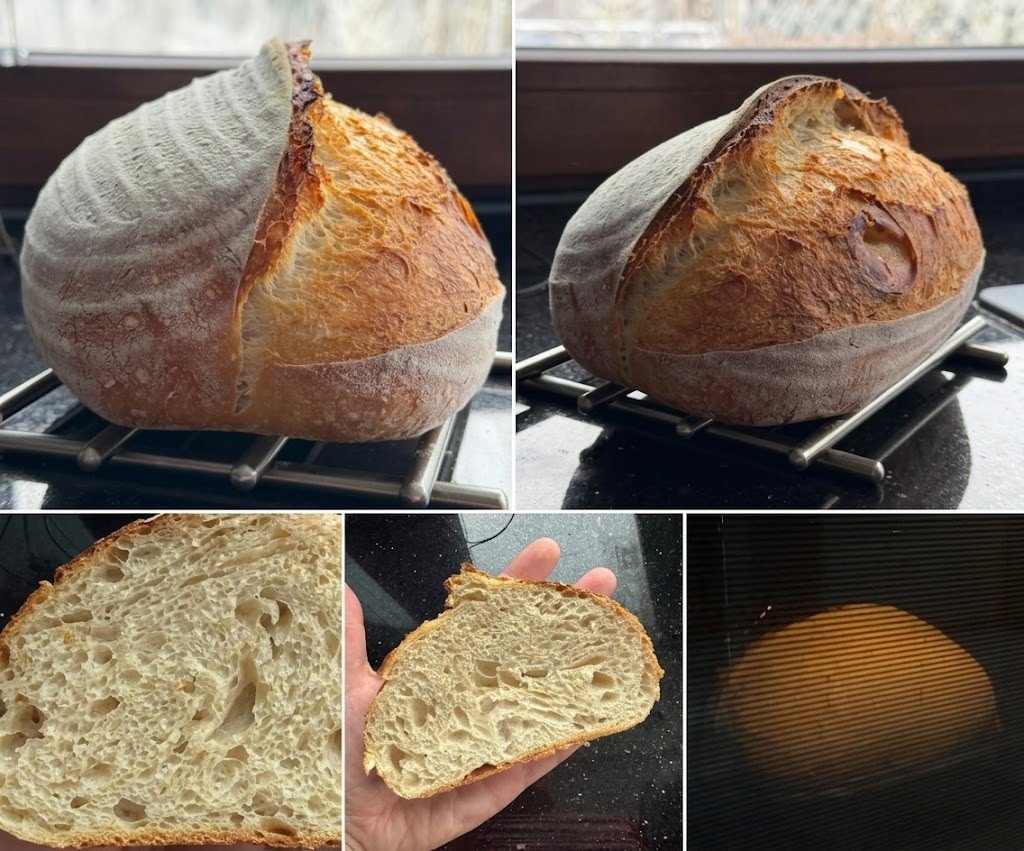
- Preparation time: 30–45 minutes
- Autolyse & mixing: 1 hour
- Bulk fermentation: 4–6 hours
- Cold proof: 8–12 hours
- Baking time: 40–45 minutes
- Total time: ~14–18 hours (including resting and proofing)
Ingredients (1 large loaf)
- 500g bread flour (high protein preferred)
- 350g water (70% hydration)
- 100g active sourdough starter (100% hydration)
- 10g salt
Optional:
- Rice flour (for dusting banneton)
- Ice cubes (for oven steam)
Equipment
- Large mixing bowl
- Kitchen scale
- Dough scraper
- Banneton or bowl lined with cloth
- Dutch oven or heavy baking pot
- Razor blade or sharp knife (for scoring)
Step-by-Step Method
1. Autolyse (Resting Phase)
Time: 60 minutes
Intensity: Very low
Mix 500g flour and 350g water until no dry flour remains. Do not add salt or starter yet. Cover the bowl and let it rest at room temperature (24–26°C).
Purpose: This allows gluten to begin forming naturally, improving dough elasticity without kneading.
2. Mixing the Dough
Time: 10–15 minutes
Intensity: Medium
Add:
- 100g active starter
- 10g salt
Mix thoroughly by hand using a folding and squeezing motion. The dough will feel sticky and shaggy at first, then gradually become smoother.
Tip: Wet your hands slightly to reduce sticking.
3. Bulk Fermentation (First Rise)
Time: 4–6 hours
Temperature: 24–28°C
Intensity: Low to medium (intermittent handling)
Place dough in a lightly oiled bowl and cover.
During the first 2 hours, perform stretch and folds every 30 minutes:
- Lift dough from one side
- Stretch upward
- Fold over itself
- Rotate bowl and repeat (4 sides)
After 2 hours, allow the dough to rest undisturbed.
What to look for:
- Dough increases in volume by 50–70%
- Surface becomes airy and slightly domed
- Bubbles form along sides
4. Pre-Shaping
Time: 10 minutes
Intensity: Medium
Transfer dough to a lightly floured surface. Shape it gently into a loose round. Let it rest uncovered for 15–20 minutes.
Purpose: Helps gluten relax before final shaping.
5. Final Shaping
Time: 10–15 minutes
Intensity: Medium to firm
Shape dough into a tight boule or oval:
- Fold edges toward the center
- Flip seam-side down
- Use hands to create surface tension by dragging dough toward you
Place into a floured banneton.
6. Cold Proof (Retardation)
Time: 8–12 hours
Temperature: 3–5°C (refrigerator)
Intensity: Passive
Cover dough and refrigerate overnight.
Purpose:
- Enhances flavor complexity
- Improves crust development
- Makes scoring easier
7. Baking
Preheating
Time: 45–60 minutes
Temperature: 250°C
Place Dutch oven inside oven and preheat thoroughly.
Scoring & Loading
Intensity: High (quick action required)
Remove dough from fridge. Turn it onto parchment paper. Score the surface using a sharp blade (1–2 cm deep cut).
Carefully place into hot Dutch oven. Add 2–3 ice cubes for steam if needed.
Baking Process
- Covered phase:
- 20 minutes at 250°C
- Creates oven spring and traps steam
- Uncovered phase:
- 20–25 minutes at 220°C
- Develops golden-brown crust
Cooling
Time: Minimum 1 hour
Intensity: Passive
Transfer bread to a wire rack. Do not cut immediately—crumb structure needs time to set.
Texture & Quality Indicators
A well-baked sourdough should have:
- Crisp, crackling crust
- Open, irregular crumb structure
- Slight tangy aroma
- Elastic chew without gumminess
Common Adjustments (Intensity Control)
- Stronger sour flavor: Extend cold proof up to 18 hours
- More open crumb: Increase hydration to 75–78%
- Less dense bread: Add extra stretch-and-fold cycle
- Milder flavor: Reduce fermentation time slightly
Nutrition Information (per 1 slice, ~50g)
- Calories: 130 kcal
- Carbohydrates: 25g
- Protein: 4g
- Fat: 0.5g
- Fiber: 1g
- Sodium: 190mg