-
Prep Time: 15 minutes
-
Rest Time: 10 minutes
-
Cook Time: 10 minutes (approx. 2 minutes per flatbread)
-
Total Time: 35 minutes
-
Servings: 6 flatbreads
-
Recipe Intensity (Difficulty Level): Beginner / Easy
-
Heat Intensity: Low (Skillet cooked over Medium-High Heat: $200^\circ\text{C}$ / $400^\circ\text{F}$)
Recipe Intensity & Technical Details
Understanding the intensity levels of this recipe ensures perfect execution every single time:
-
Skill Intensity (2/5 – Low): Perfect for beginners. No complex dough manipulation or yeast activation is required.
-
Physical Intensity (2/5 – Low): Minimal kneading needed—just enough to bring the dough together smoothly (about 2–3 minutes).
-
Thermal Intensity (4/5 – High): Cooking requires high, direct heat. A hot cast-iron skillet creates those signature golden-brown char spots without drying out the bread’s interior.
Ingredients
For the Dough:
-
All-Purpose Flour: 2 cups ($240\text{ g}$), plus extra for dusting
-
Baking Powder: $1\frac{1}{2}\text{ teaspoons}$ (acts as the leavening agent for rapid rise)
-
Fine Sea Salt: $1\text{ teaspoon}$
-
Plain Greek Yogurt: $\frac{3}{4}\text{ cup}$ ($180\text{ g}$), full-fat preferred for tenderness
-
Warm Water: $\frac{1}{3}\text{ cup}$ ($80\text{ ml}$)
-
Olive Oil: 2 tablespoons ($30\text{ ml}$), plus extra for coating
Optional Garlic Butter Finish:
-
Unsalted Butter: 3 tablespoons ($45\text{ g}$), melted
-
Garlic: 2 cloves, finely minced
-
Fresh Parsley or Cilantro: 2 tablespoons, finely chopped
-
Flaky Sea Salt: A pinch for topping
Equipment Needed
-
Large mixing bowl
-
Measuring cups and spoons
-
Wooden spoon or spatula
-
Rolling pin
-
Heavy-bottomed pan or Cast-Iron Skillet (10 to 12 inches)
-
Tongs or a flat spatula
-
Pastry brush
Step-by-Step Instructions
Step 1: Combine the Dry Ingredients
In a large mixing bowl, whisk together the all-purpose flour, baking powder, and fine sea salt until evenly distributed. Making sure the baking powder is thoroughly mixed prevents uneven rising.
Step 2: Form the Dough
Create a small well in the center of the dry ingredients. Add the plain Greek yogurt, warm water, and olive oil into the well. Using a wooden spoon, begin stirring from the inside out, gradually incorporating the flour into the wet ingredients until a shaggy dough begins to form.
Step 3: Knead and Rest
Turn the shaggy dough out onto a lightly floured surface. Gently knead the dough for 2 to 3 minutes. You are not trying to build heavy gluten networks here; simply knead until the dough comes together into a smooth, cohesive ball. If the dough feels too sticky, add flour one tablespoon at a time.
Cover the dough ball with a clean kitchen towel or inverted bowl and let it rest at room temperature for 10 minutes. Resting allows the gluten to relax, making the dough significantly easier to roll out without springing back.
Step 4: Divide and Roll
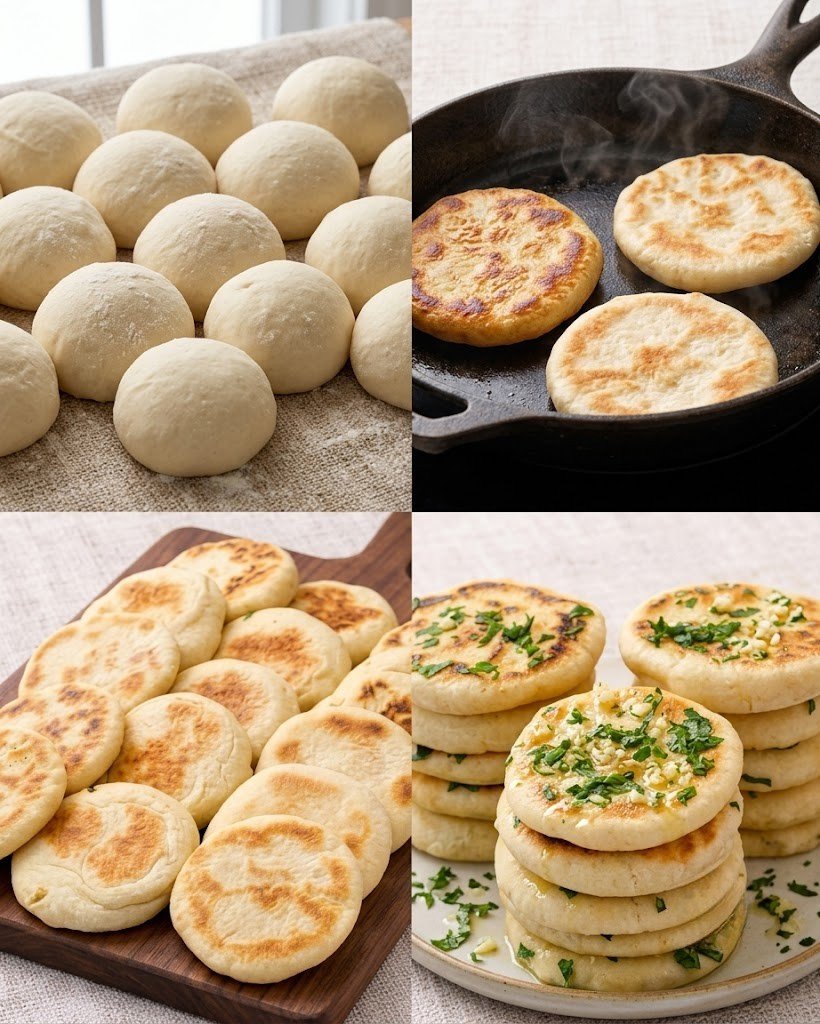
After resting, cut the dough into 6 equal pieces. Roll each piece into a smooth ball.
Lightly flour your work surface and rolling pin. Take one ball of dough and roll it out into a flat oval or circle about $\frac{1}{8}\text{-inch}$ thick (approximately 6 to 7 inches in diameter). Do not worry about making perfect circles—rustic shapes add to the homemade charm!
Step 5: Cook in the Skillet
Place your cast-iron skillet or heavy pan over medium-high heat for 3 to 5 minutes until it is very hot. Lightly wipe the pan with a paper towel dabbed in olive oil (do not leave standing oil, as we want to dry-sear the flatbread).
-
Carefully lay one flatbread flat into the hot skillet.
-
Cook for 1 to $1\frac{1}{2}$ minutes. You will notice large bubbles forming across the surface and the underside gaining golden-brown spots.
-
Flip the flatbread using tongs and cook the second side for another 45 to 60 seconds until lightly charred and fully cooked through.
-
Transfer the hot flatbread to a plate and cover it immediately with a clean kitchen towel to trap the steam. This step is essential for keeping the bread soft and pliable.
Repeat the process with the remaining dough portions.
Step 6: Brush and Serve
While the flatbreads are warm, mix the melted butter, minced garlic, and chopped fresh herbs together. Generously brush each flatbread with the garlic butter mixture and finish with a sprinkle of flaky sea salt.
Storage & Shelf Life (The Last of the Recipe)
Proper storage ensures your flatbreads remain fresh and soft for days:
-
Room Temperature: Store cooled flatbreads in an airtight plastic bag or wrapped tightly in foil at room temperature for up to 3 days.
-
Refrigeration: Keep in an airtight container in the refrigerator for up to 7 days.
-
Freezing: Stack cooked flatbreads with sheets of parchment paper between them to prevent sticking. Place the stack in a freezer-safe zip-top bag. Freeze for up to 3 months.
-
Reheating Instructions:
-
Skillet: Reheat in a dry pan over medium heat for 30 seconds per side.
-
Oven: Wrap in aluminum foil and warm at $175^\circ\text{C}$ ($350^\circ\text{F}$) for 5 to 7 minutes.
-
Microwave: Wrap a flatbread in a damp paper towel and microwave for 15 seconds.
-
Nutritional Information
(Estimated values per serving, based on 1 flatbread without optional garlic butter finishing)
| Nutrient | Amount Per Serving | % Daily Value* |
| Calories | 195 kcal | — |
| Total Fat | 5.5 g | 7% |
| Saturated Fat | 1.2 g | 6% |
| Trans Fat | 0 g | — |
| Cholesterol | 4 mg | 1% |
| Sodium | 410 mg | 18% |
| Total Carbohydrates | 30 g | 11% |
| Dietary Fiber | 1.2 g | 4% |
| Sugars | 1.1 g | — |
| Protein | 6.2 g | 12% |
| Calcium | 85 mg | 7% |
| Iron | 1.8 mg | 10% |