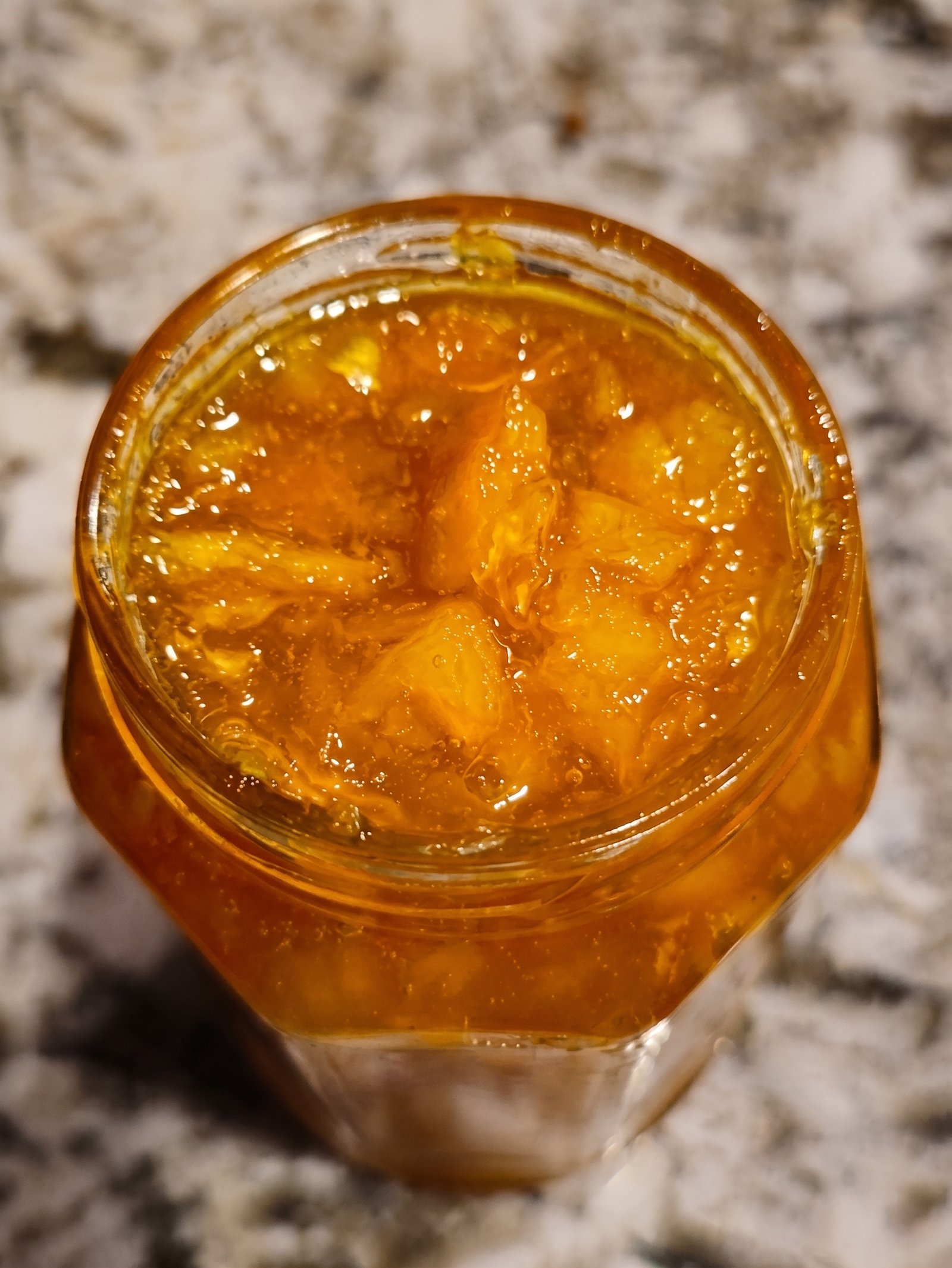
-
Prep Time: 30 minutes
-
Simmer / Softening Time: 45 minutes
-
Boil / Gel Point Time: 20–25 minutes
-
Total Active Time: 1 hour 35 minutes (plus cooling/setting time)
-
Yield: Approximately 4 half-pint (8 oz / 240 ml) jars (32 servings total, 1 tbsp per serving)
-
Heat Intensity: Low-to-Medium (Softening Stage) transitioning to High / Rolling Boil (Pectin Activation Stage)
-
Cuisine: Traditional British / European Preserves
-
Dietary Profile: Vegan, Gluten-Free, Dairy-Free, Naturally Preserved
Equipment Needed
-
4 glass canning jars (8 oz / 250 ml) with new lids and bands
-
Heavy-bottomed stainless steel or enameled Dutch oven (minimum 5–6 quart capacity)
-
Sharp chef’s knife and cutting board
-
Cheesecloth and kitchen twine (for seeds and pith sachet)
-
Candy/deep-fry thermometer
-
2–3 small ceramic plates (placed in the freezer for the wrinkle test)
-
Wide-mouth canning funnel and ladle
-
Water bath canner or deep stockpot with a rack
Ingredients
-
2 lbs (approx. 900 g) fresh organic oranges: Seville/bitter oranges are traditional; sweet varieties like Navel, Valencia, or Cara Cara work well with added lemon juice.
-
2 large organic lemons: Provides high natural pectin and balancing acidity.
-
4 cups (800 g) granulated white sugar: Essential for proper gel structure, clarity, and shelf-life preservation.
-
5 cups (1.2 L) filtered water: For simmering the peels to tender perfection.
-
1/2 tsp unsalted butter (optional): To reduce surface foaming during the hard boil.
Step-by-Step Instructions
Step 1: Prep the Citrus and Extract Natural Pectin
-
Wash and scrub the citrus thoroughly under warm water to remove any wax or surface residue.
-
Cut the oranges and lemons in half. Juice them completely into a large bowl through a fine-mesh strainer, reserving every seed and membrane left behind.
-
Place all the collected seeds and tough central white membranes into a double layer of cheesecloth. Tie it tightly into a pouch using kitchen twine. This sachet is packed with natural pectin, which sets the marmalade naturally.
Step 2: Slice the Rind
-
Use a spoon to scrape away any excessive spongy white pith from the inside of the juiced peel halves if you prefer a sweeter marmalade, or leave some intact for traditional bitterness.
-
Slice the citrus peel into thin slivers (roughly 1/16-inch to 1/8-inch thick, or finely shredded depending on your preferred texture).
Step 3: Soften the Peels (Low-to-Medium Heat Intensity)
-
In your heavy-bottomed pot, combine the sliced peels, fresh citrus juice, water, and the cheesecloth pectin bag.
-
Bring the mixture to a boil over medium-high heat.
-
Once boiling, reduce the heat to low-medium, cover partially with a lid, and let it gently simmer for 40 to 45 minutes. The peels should become translucent and tender enough to easily crush between your thumb and forefinger.
-
Remove from heat. Squeeze the cheesecloth pouch against the side of the pot using a wooden spoon to extract the thick pectin-rich juices back into the pot, then discard the pouch.
Step 4: Add Sugar & Reach the Gel Point (High Heat Intensity)
-
Add the granulated sugar (and optional butter) to the pot. Stir constantly over low heat until the sugar crystals are completely dissolved.
-
Increase heat to high to bring the mixture to a vigorous, rapid rolling boil that cannot be stirred down.
-
Clip a candy thermometer to the side of the pot. Boil rapidly for 15 to 25 minutes, stirring frequently to prevent scorching at the base.
-
Watch for the temperature to reach 220°F (105°C) at sea level (the standard citrus jellying point).
Step 5: Test the Set (The Freezer Plate Method)
-
Remove the pot from heat to prevent overcooking while testing.
-
Spoon a small drop of hot marmalade onto one of your pre-chilled freezer plates and let it sit for 60 seconds.
-
Push the edge of the droplet gently with your finger:
-
If it wrinkles and holds its shape: The marmalade is done.
-
If it runs or feels thin: Return the pot to high heat and boil for another 2–3 minutes before retesting.
-
Step 6: Jarring and Processing
-
Skim off any light foam from the surface with a metal spoon.
-
Allow the marmalade to rest off the heat for 5 to 8 minutes; stirring once or twice before ladling suspends the peel evenly instead of floating to the top.
-
Ladle hot marmalade into warm, sterilized jars, leaving 1/4-inch (0.6 cm) of headspace.
-
Wipe the jar rims with a clean, damp cloth, place the flat lids on top, and screw down the bands until fingertip-tight.
-
For Long-Term Shelf Storage: Process the sealed jars in a boiling water bath canner for 10 minutes (adjusting for altitude: add 5 minutes for 1,000–3,000 ft, 10 minutes above 3,000 ft).
-
Remove jars and allow them to cool undisturbed on a towel-lined counter for 12 to 24 hours. Check that all lids have sealed (the center button should pop down and not bounce).
Flavor Variations
-
Spiced Orange Marmalade: Add 1 cinnamon stick, 2 whole star anise, and 3 crushed cardamom pods into the pectin cheesecloth pouch during the softening stage.
-
Ginger-Orange Marmalade: Add 2 tablespoons of finely grated fresh ginger root along with the sliced peels in Step 3.
-
Whiskey or Bourbon Infusion: Stir in 2 tablespoons of aged bourbon or Scotch whiskey immediately after turning off the heat in Step 5 before ladling.
Nutritional Information
(Calculated per 1 Tablespoon / 20 g serving)
| Nutrient | Amount Per Serving | % Daily Value |
| Calories | 50 kcal | 2.5% |
| Total Fat | 0 g | 0% |
| Saturated Fat | 0 g | 0% |
| Trans Fat | 0 g | — |
| Cholesterol | 0 mg | 0% |
| Sodium | 1 mg | <1% |
| Total Carbohydrates | 13 g | 4.7% |
| Dietary Fiber | 0.4 g | 1.4% |
| Total Sugars | 12.5 g | — |
| Added Sugars | 12.5 g | 25% |
| Protein | 0.1 g | <1% |
| Vitamin C | 4.5 mg | 5% |
| Calcium | 6 mg | <1% |
| Potassium | 18 mg | <1% |