| Prep Time | 20 minutes |
| Proofing / Rest Time | 45 minutes |
| Cook Time | 10 minutes |
| Total Time | 1 hour 15 minutes |
| Cooking Intensity | Medium-High Heat ($400^\circ\text{F} / 205^\circ\text{C}$ equivalent skillet surface) |
| Yield | 8 Flatbreads |
| Difficulty | Beginner to Intermediate |
Ingredients
For the Yeast Starter:
-
Warm Water ($105^\circ\text{F} – 110^\circ\text{F}$): $1\ \text{cup}$ ($240\ \text{ml}$)
-
Active Dry Yeast: $2\frac{1}{4}\ \text{tsp}$ ($1\ \text{packet}$)
-
Granulated Sugar or Honey: $1\ \text{tsp}$
For the Dough:
-
All-Purpose Flour or Bread Flour: $3\ \text{cups}$ ($360\ \text{g}$), plus extra for dusting
-
Full-Fat Whole Milk Yogurt or Greek Yogurt (Room Temp): $\frac{1}{3}\ \text{cup}$ ($80\ \text{g}$)
-
Extra Virgin Olive Oil: $2\ \text{tbsp}$ ($30\ \text{ml}$)
-
Fine Sea Salt: $1\frac{1}{2}\ \text{tsp}$ ($9\ \text{g}$)
-
Baking Powder: $\frac{1}{2}\ \text{tsp}$ (provides extra softness and instant lift)
For the Herb & Garlic Butter Finishing:
-
Unsalted Butter (Melted): $4\ \text{tbsp}$ ($60\ \text{g}$)
-
Garlic (Minced): $2\ \text{cloves}$
-
Fresh Parsley or Cilantro (Finely Chopped): $2\ \text{tbsp}$
-
Flaky Sea Salt: Pinch for sprinkling
Step-by-Step Instructions
1. Activate the Yeast
In a liquid measuring cup or small bowl, combine the warm water, granulated sugar, and active dry yeast. Whisk gently to combine. Allow the mixture to sit at room temperature for 5 to 7 minutes. The yeast is active and ready when a thick, frothy layer forms on top.
2. Mix the Dough
In a large mixing bowl, whisk together the flour, fine sea salt, and baking powder. Create a well in the center of the dry ingredients. Pour in the activated yeast mixture, room-temperature yogurt, and olive oil. Using a wooden spoon or sturdy spatula, stir from the inside out until a shaggy dough forms.
3. Knead to Perfection
Turn the dough out onto a lightly floured work surface. Knead continuously for 6 to 8 minutes (or process in a stand mixer fitted with a dough hook for 5 minutes on medium-low speed). The dough should transform from sticky and rough to smooth, elastic, and supple. If the dough feels overly sticky, add additional flour $1\ \text{tbsp}$ at a time.
4. First Rest (Proofing)
Lightly grease a clean bowl with olive oil. Place the dough inside, turning it once so the top is lightly coated. Cover the bowl securely with a damp kitchen towel or plastic wrap. Place in a warm, draft-free spot for 45 minutes, or until doubled in size.
5. Portion and Shape
Gently punch down the risen dough to release excess gas. Transfer to a floured surface and divide equally into 8 pieces (roughly $80\ \text{g}$ each). Roll each piece into a smooth ball. Cover the dough balls with a light towel and allow them to rest for 10 minutes to relax the gluten, making them effortless to roll out.
6. Rolling Out
Take one dough ball at a time, keeping the remaining pieces covered. Dust your rolling pin and work surface lightly with flour. Roll the ball into a circle or oval roughly $7-8\ \text{inches}$ in diameter and about $\frac{1}{8}\ \text{inch}$ thick.
7. Cooking with Precision (Pan-Searing)
-
Intensity / Heat Setting: Set a heavy cast-iron skillet, carbon steel pan, or flat griddle over Medium-High heat. Pre-heat the dry pan for 3 to 5 minutes until light wisps of smoke appear.
-
First Side: Place one rolled flatbread directly onto the hot, ungreased skillet. Cook for 60 to 90 seconds. You will notice large bubbles billowing across the surface and golden-brown blistering on the bottom side.
-
Flip and Puff: Flip the flatbread using tongs. Cook the second side for another 45 to 60 seconds, gently pressing down on the edges with a spatula to encourage even rising and steam creation inside the bread.
-
Optional Direct Flame Charing: For an authentic open-fire touch, use tongs to hold the cooked flatbread directly over an open gas burner flame for 5 to 10 seconds per side until lightly charred along the edges.
8. Finish with Butter and Serve
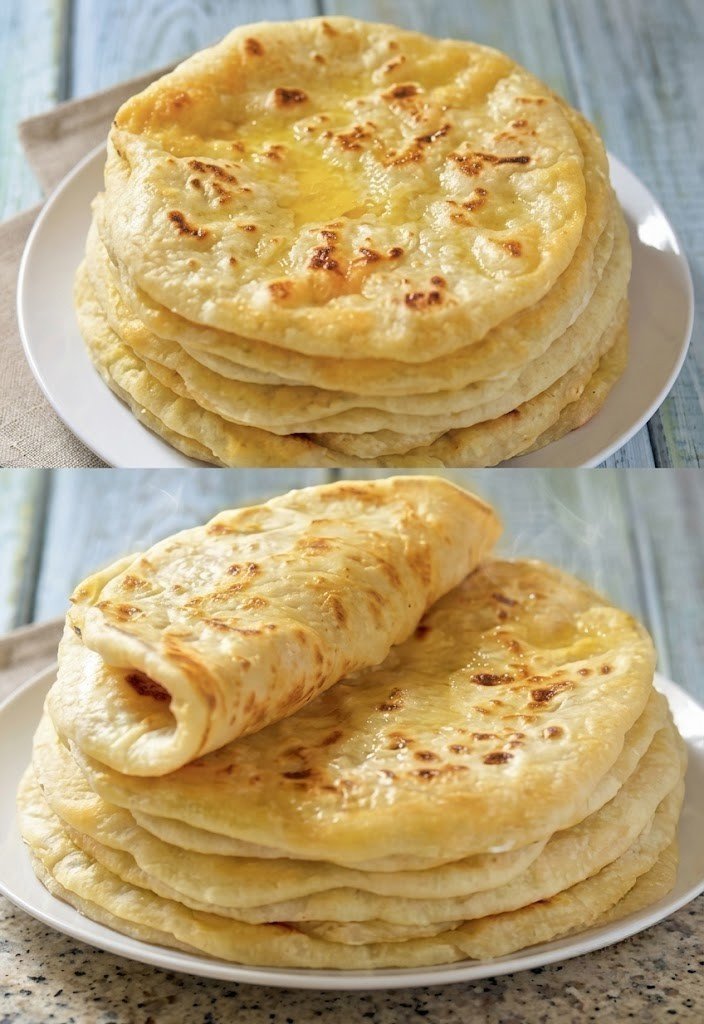
Remove the cooked flatbread from the heat and place it on a clean plate. Immediately brush generously with the garlic-herb melted butter mixture and sprinkle with a touch of flaky sea salt. Stack cooked flatbreads on top of each other and cover with a clean cloth towel to trap steam, keeping them warm, soft, and pliable while cooking the remaining batch.
Chef’s Pro-Tips for Success
-
Don’t Skip the Yogurt: The natural acidity in yogurt softens the gluten strands, giving Bidda Flatbread its characteristic pillowy bite and extended softness.
-
Maintain High Heat: Cooking flatbread over low heat dries it out, making it tough and cracker-like. High heat cooks the interior rapidly via trapped steam while searing the exterior quickly.
-
Storage & Reheating: Store leftover flatbreads in an airtight bag at room temperature for up to 3 days or freeze for up to 3 months. Reheat individual pieces on a hot skillet for 20 seconds per side or in an air fryer at $350^\circ\text{F}$ ($175^\circ\text{C}$) for 1 to 2 minutes.
Nutrition Information
Calculated per serving (1 flatbread with garlic butter topping).
| Nutrient | Amount per Serving | % Daily Value* |
| Calories | $245\ \text{kcal}$ | — |
| Total Fat | $8.5\ \text{g}$ | $11\%$ |
| Saturated Fat | $4.0\ \text{g}$ | $20\%$ |
| Trans Fat | $0.0\ \text{g}$ | — |
| Cholesterol | $16\ \text{mg}$ | $5\%$ |
| Sodium | $460\ \text{mg}$ | $20\%$ |
| Total Carbohydrates | $34.0\ \text{g}$ | $12\%$ |
| Dietary Fiber | $1.5\ \text{g}$ | $5\%$ |
| Sugars | $1.2\ \text{g}$ | — |
| Protein | $6.2\ \text{g}$ | $12\%$ |
| Calcium | $45\ \text{mg}$ | $4\%$ |
| Iron | $2.1\ \text{mg}$ | $12\%$ |
| Potassium | $85\ \text{mg}$ | $2\%$ |