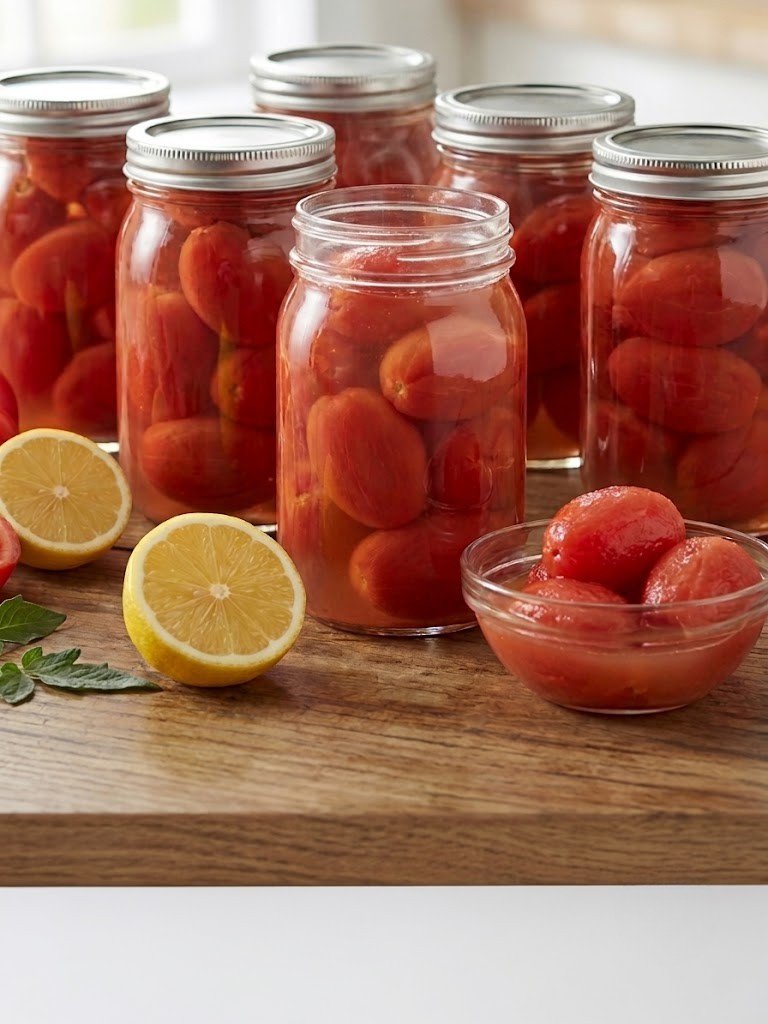
| Prep Time | 45 minutes | Washing, scoring, blanching, peeling, and packing jars |
| Processing Time | 85 minutes | Water-bath processing for quart jars at sea level (adjust for altitude) |
| Total Time | 2 hours 10 minutes | Active kitchen work (excludes overnight cooling) |
| Yield | 7 Quarts | Approximately 14–15 lbs of tomatoes needed total |
| Skill Level | Intermediate | Requires attention to thermal processing and jar sterilization |
| Heat Intensity | High Rolling Boil | Water bath must maintain a continuous $212^\circ\text{F}$ ($100^\circ\text{C}$) boil |
| Acidity Level | High ($pH < 4.6$) | Mandated acidification with bottled lemon juice or citric acid |
Essential Ingredients
-
14 to 15 lbs Fresh Plum/Roma Tomatoes: Choose firm, ripe tomatoes free of rot or disease. Paste tomatoes (like Roma, San Marzano, or Amish Paste) yield the best results because they have thicker walls and lower water content.
-
Bottled Lemon Juice: 2 tablespoons per quart jar (or 1/2 teaspoon citric acid per quart jar). Note: Always use commercially bottled lemon juice to ensure a consistent, safe pH level.
-
Canning Salt (Optional): 1 teaspoon per quart jar (for flavor only; salt does not act as a preservative here).
-
Boiling Water or Hot Tomato Juice: Roughly 4 to 6 cups needed to top off the jars.
Essential Canning Equipment
-
Water-bath canner with fitted rack
-
7 quart-sized Mason jars with fresh two-piece flat lids and bands
-
Large stockpot (for blanching tomatoes)
-
Large bowl filled with ice water (ice bath)
-
Jar lifter tongs, bubble remover tool (or non-metallic spatula), and magnetic lid lifter
-
Canning funnel and clean kitchen towels
Step-by-Step Processing Guide
Precision and order matter greatly in home canning to eliminate the risk of Clostridium botulinum spores and ensure an airtight seal.
Pro-Tips for Canning Success
Crucial Food Safety Note: Tomatoes have a natural pH borderline between high-acid and low-acid foods due to modern hybrid breeding. Adding commercial bottled lemon juice guarantees an acidic environment ($pH < 4.6$), which completely prevents bacterial growth during room temperature storage.
-
Choosing the Right Tomato: Roma or San Marzano varieties contain less juice and seeds, yielding denser preserved tomatoes that won’t float as easily in the jar.
-
Checking Vacuum Seals: After 24 hours, unscrew the outer metal bands. Lift each jar gently by the edges of the metal lid. If the lid stays locked tight, your seal is solid. Store jars without the screw bands so moisture won’t cause rusting.
-
Shelf Life: Properly canned tomatoes keep their best quality, flavor, and color for 12 to 18 months in a dark, cool pantry ($50^\circ\text{F}$ to $70^\circ\text{F}$).
Nutritional Analysis
The values below represent the nutritional profile for one standard serving of home-canned whole tomatoes packed in light natural tomato juice without added fats or oil.
Per 1/2 Cup Serving (approx. 120g)
| Nutrient | Amount Per Serving | % Daily Value (DV)* |
| Calories | 22 kcal | — |
| Total Fat | 0.2 g | 0% |
| Saturated Fat | 0.03 g | 0% |
| Trans Fat | 0 g | — |
| Sodium | 350 mg (with added salt) | 15% |
| Total Carbohydrates | 4.8 g | 2% |
| Dietary Fiber | 1.4 g | 5% |
| Total Sugars | 3.1 g | — |
| Added Sugars | 0 g | 0% |
| Protein | 1.1 g | 2% |
| Vitamin C | 17.4 mg | 20% |
| Vitamin A | 51 mcg RAE | 6% |
| Potassium | 290 mg | 6% |
| Lycopene | 3,100 mcg | Antioxidant Power |