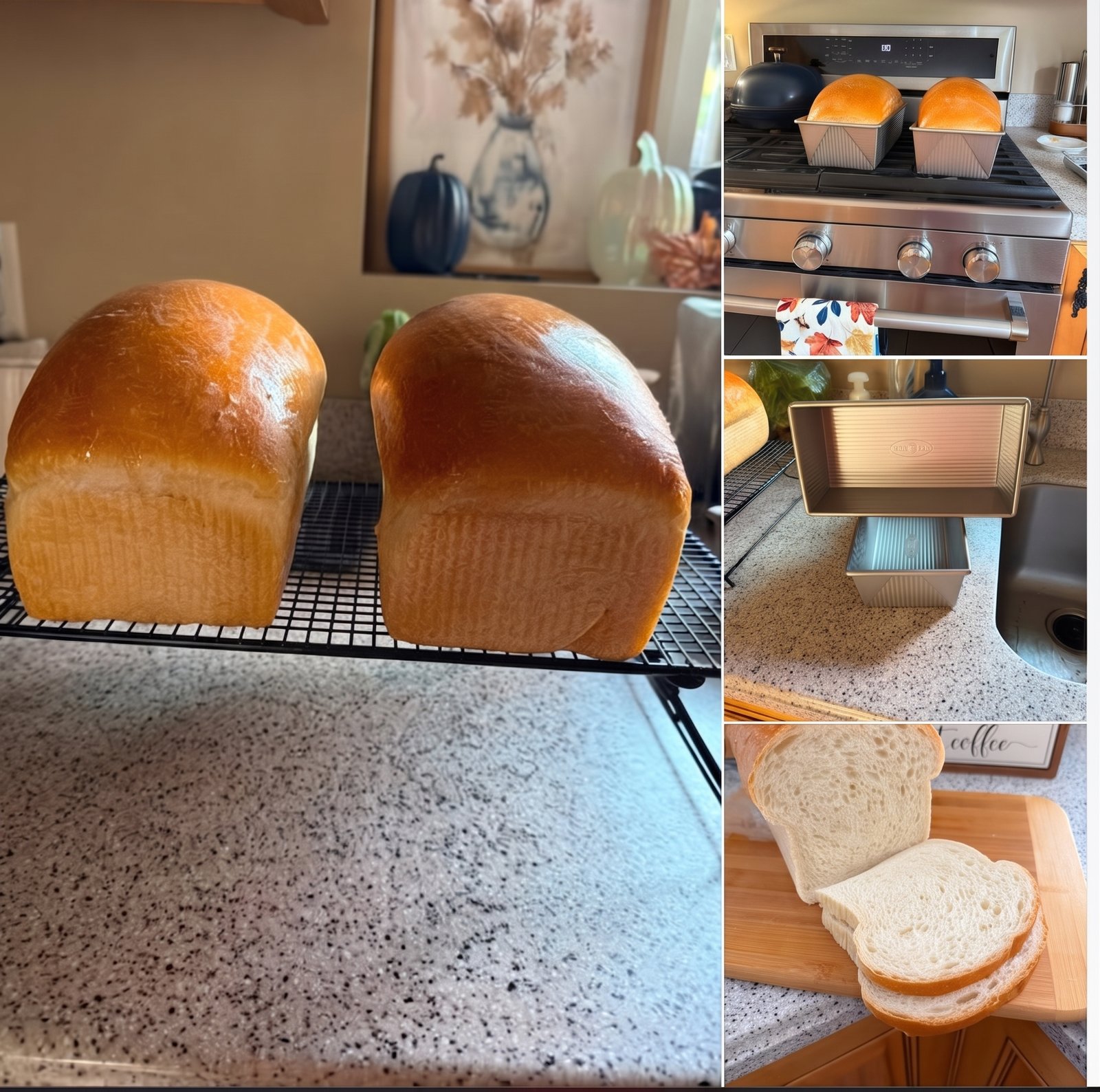
-
Prep Time: 45 minutes
-
Rise & Proof Time: 2 hours 30 minutes
-
Bake Time: 30 to 35 minutes
-
Total Time: Approximately 3 hours 35 minutes
-
Yield: One standard 9×4-inch pullman loaf or two standard 8.5×4.5-inch loaf pans
-
Intensity Level: Medium-High (Requires precise measurements, dough handling, and the tangzhong technique)
Ingredients
To achieve the signature texture of authentic Japanese milk bread, exact ingredients and ratios are essential.
The Tangzhong (Water Roux Starter)
-
Bread Flour: 3 tablespoons (approx. 25g)
-
Water: 1/4 cup (60ml)
-
Whole Milk: 1/4 cup (60ml)
The Main Dough
-
Bread Flour: 3 1/2 cups (approx. 420g; high-protein bread flour is strongly recommended for structure)
-
Granulated Sugar: 1/4 cup (50g)
-
Active Dry Yeast or Instant Yeast: 2 1/4 teaspoons (1 standard packet / 7g)
-
Salt: 1 1/2 teaspoons
-
Whole Milk (Lukewarm): 3/4 cup (180ml)
-
Large Egg: 1 large (at room temperature)
-
Unsalted Butter: 4 tablespoons (60g, softened to room temperature for easy incorporation)
Step-by-Step Instructions
Baking shokupan is a rewarding, therapeutic process. Follow these detailed steps to ensure your loaf turns out exceptionally light and fluffy.
Step 1: Make the Tangzhong Starter
-
In a small saucepan, whisk together the 3 tablespoons of bread flour, 1/4 cup of water, and 1/4 cup of milk until completely smooth and free of lumps.
-
Place the saucepan over low heat, whisking constantly. Cook the mixture for about 3 to 5 minutes.
-
As it heats, it will rapidly thicken into a smooth, paste-like consistency (resembling mashed potato paste or a thick pudding).
-
Remove it from the heat, transfer it to a clean bowl, and let it cool down to room temperature before adding it to your main dough.
Step 2: Combine the Dry Ingredients and Yeast
In the bowl of a stand mixer fitted with the dough hook attachment, combine the 3 1/2 cups of bread flour, sugar, instant yeast, and salt. Stir briefly to distribute the ingredients evenly.
Step 3: Mix the Dough
-
Add the cooled tangzhong paste, lukewarm milk, and the room-temperature egg to the dry ingredients.
-
Turn the mixer on low speed and mix for about 3 to 4 minutes until the ingredients come together into a shaggy dough.
Step 4: Knead and Incorporate Butter
-
Once the dough has formed, increase the mixer speed to medium. Continue kneading for about 5 minutes until the dough begins to smooth out.
-
Add the softened butter one tablespoon at a time, waiting until each piece is fully incorporated before adding the next.
-
After all the butter is added, continue kneading the dough on medium speed for another 10 to 12 minutes. The dough should transform from sticky to smooth, elastic, and slightly tacky. It should pass the windowpane test: when you gently stretch a small piece of dough between your fingers, it should stretch into a thin, translucent membrane without tearing easily.
Step 5: First Rise (Bulk Fermentation)
-
Shape the dough into a smooth, tight ball by tucking the edges underneath.
-
Place the dough in a lightly oiled bowl, cover it with plastic wrap or a damp kitchen towel, and let it rise in a warm, draft-free place for 1 to 1.5 hours, or until it has doubled in size.
Step 6: Punch Down, Divide, and Shape
-
Gently deflate the risen dough and turn it out onto a clean, lightly floured work surface.
-
Divide the dough into 3 equal portions (for a standard pullman loaf) or 4 portions. Round each portion into a smooth ball and cover them with a towel, letting them rest for 15 minutes to relax the gluten.
-
Take one dough ball and roll it out with a rolling pin into a flat, elongated oval shape.
-
Fold the two outer long sides inward toward the center to create a neat rectangle. Starting from the bottom short end, roll the rectangle tightly upward into a neat cylinder, pressing lightly to seal. Repeat with the remaining dough balls.
Step 7: Second Rise (Final Proof)
-
Place the rolled cylinders side-by-side into a greased loaf pan (or pullman loaf pan).
-
Cover the pan and let it rise in a warm environment for 45 to 60 minutes. The dough is ready when it fills about 80% to 90% of the pan, or sits just below the rim. (If using a pullman pan with a lid slid halfway on, let it rise until it reaches about an inch from the top).
Step 8: Bake to Golden Perfection
-
Preheat your oven to 350 degrees Fahrenheit (175 degrees Celsius).
-
If desired, lightly brush the top of the exposed dough with a little whole milk or an egg wash for a shiny, golden finish.
-
Bake on the middle rack for 30 to 35 minutes. If the top begins browning too quickly during the first 20 minutes, loosely tent a piece of aluminum foil over the loaf to prevent scorching.
-
Once baked, remove the loaf from the oven immediately. Turn it out of the pan onto a wire cooling rack so the air circulates around all sides, preventing a soggy crust. Allow it to cool completely before slicing.
Storage and Freshness Tips
-
Room Temperature Storage: Because of the tangzhong method, Japanese milk bread retains moisture exceptionally well. Store it in an airtight container or a bread bag at room temperature for up to 3 to 4 days.
-
Freezing: Shokupan freezes wonderfully. Slice the cooled loaf completely, place parchment paper between the slices, and store them in a heavy-duty freezer bag for up to 2 months. You can pop frozen slices straight into the toaster for an instant, fresh-baked experience.
Nutritional Information
Serving size: 1 slice (approx. 1/10th of a standard loaf)
-
Calories: 165 kcal
-
Protein: 5 g
-
Total Carbohydrates: 28 g
-
Dietary Fiber: 1 g
-
Sugars: 5 g
-
Total Fat: 4 g
-
Sodium: 180 mg