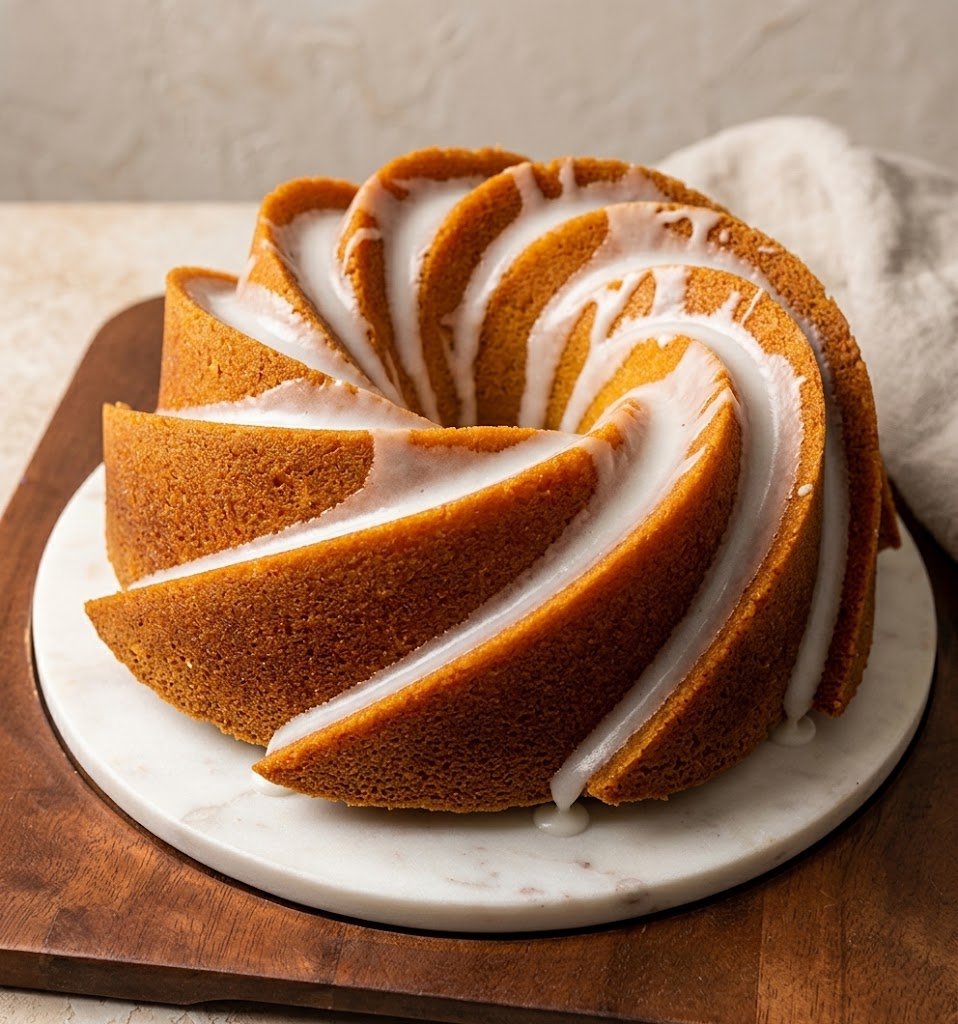
-
Prep Time: 25 minutes
-
Bake Time: 55–65 minutes
-
Cooling Time: 10 minutes in pan + 1 hour on wire rack
-
Total Time: ~1 hour 35 minutes (plus cooling)
-
Skill Level / Intensity: Intermediate Baking (Requires precise creaming and gentle folding)
-
Yield: 12 to 14 generous slices
-
Pan Type: 10 to 12-cup standard or sculptural Bundt pan (such as a Nordic Ware Heritage/Spiral pan)
Baking Intensity & Temperature Guide
Precision in temperature and mixing speed is essential to prevent a dense or rubbery cake crumb:
-
Oven Heat: 350°F (177°C) — Standard bake with the rack positioned dead center. Avoid convection/fan mode if possible, as it can dry out the high surface area of a Bundt cake.
-
Ingredient Temperature: All refrigerated ingredients (butter, eggs, sour cream, milk) must be at room temperature (65°F–70°F / 18°C–21°C). This allows the fat and liquid emulsion to form properly without curdling.
-
Creaming Intensity: Medium-High Speed (Speed 6 on a stand mixer) for a full 4 to 5 minutes until light, pale, and fluffy.
-
Flour Incorporation Intensity: Low Speed (Speed 1–2) or Fold by Hand with a Silicone Spatula. Never overmix once the flour is added; overworking gluten creates a tough, gummy texture.
Ingredients
For the Lemon Cake:
-
All-purpose flour: 3 cups (360g), spooned and leveled (or cake flour for an even softer crumb)
-
Baking powder: 1 teaspoon
-
Baking soda: ½ teaspoon
-
Fine sea salt: 1 teaspoon
-
Granulated sugar: 2 cups (400g)
-
Fresh lemon zest: 3 tablespoons (finely grated from approx. 3 to 4 large organic lemons)
-
Unsalted butter: 1 cup (2 sticks / 226g), softened to room temperature
-
Large eggs: 4 whole eggs, room temperature
-
Pure vanilla extract: 1 teaspoon
-
Fresh lemon juice: ¼ cup (60ml), freshly squeezed
-
Full-fat sour cream: ½ cup (120g), room temperature
-
Whole milk: ¼ cup (60ml), room temperature
For the Luscious Lemon Glaze:
-
Powdered confectioners’ sugar: 2 cups (240g), sifted to eliminate lumps
-
Fresh lemon juice: 3 to 4 tablespoons (45–60ml), freshly squeezed
-
Pinch of salt: Small pinch (balances the powdered sugar’s sweetness)
-
Heavy cream or milk (optional): 1 teaspoon (for a more opaque, glossy finish)
Equipment Needed
-
10–12 cup Bundt pan (Cast aluminum recommended)
-
Stand mixer fitted with paddle attachment (or electric hand mixer)
-
Microplane / Fine citrus zester
-
Citrus juicer & fine-mesh strainer
-
Wire cooling rack
-
Pastry brush (for greasing the pan)
-
Large mixing bowl & silicone spatula
Step-by-Step Instructions
Step 1: Pan Prep & Oven Calibration
-
Position your oven rack in the center of the oven and preheat to 350°F (177°C).
-
Prepare your Bundt pan thoroughly. In intricate pans, flour-based baking spray (such as Baker’s Joy) or homemade cake goop (equal parts melted shortening, vegetable oil, and flour brushed into every nook and cranny) ensures a flawless release. Avoid straight melted butter, as the milk solids can cause the cake to stick.
Step 2: The Lemon-Sugar Infusion Technique
-
Add the 2 cups of granulated sugar and the 3 tablespoons of freshly grated lemon zest to the bowl of your stand mixer.
-
Using your clean fingertips, rub the lemon zest into the granulated sugar for 2 to 3 minutes.
-
The Science: The sharp edges of the sugar crystals rupture the oil glands in the lemon peel, releasing fragrant essential oils (limonene) directly into the sugar, which disperses vibrant flavor evenly throughout the batter.
Step 3: Sift the Dry Ingredients
-
In a medium mixing bowl, whisk together the flour, baking powder, baking soda, and fine sea salt until uniformly distributed. Set aside.
Step 4: Cream the Butter and Aerate
-
Add the softened room-temperature butter to the lemon-infused sugar in the stand mixer bowl.
-
Beat on medium-high speed for 4 to 5 minutes. The mixture should transition from yellow and grainy to pale, fluffy, and significantly increased in volume.
-
Add the room-temperature eggs one at a time, beating for 30 seconds after each addition. Scrape down the bottom and sides of the bowl with a spatula after every two eggs.
-
Stir in the pure vanilla extract.
Step 5: Alternate Wet & Dry Ingredients
-
In a glass measuring cup, whisk together the sour cream, whole milk, and ¼ cup fresh lemon juice (the mixture will thicken slightly like buttermilk).
-
With the mixer running on the lowest speed, add ⅓ of the dry flour mixture, followed by ½ of the sour cream mixture.
-
Repeat with another ⅓ of the flour, the remainder of the sour cream mixture, and finish with the final ⅓ of the dry ingredients.
-
Stop the mixer immediately when a few streaks of flour remain. Finish incorporating the batter by hand with a rubber spatula, making sure to scrape the very bottom of the bowl.
Step 6: Fill & Bake
-
Spoon the thick, luscious batter into the prepared Bundt pan, spreading it evenly with your spatula.
-
Tap the pan firmly against the countertop on top of a folded towel 2 to 3 times to release any trapped air bubbles from the crevices.
-
Bake at 350°F (177°C) for 55 to 65 minutes.
-
The cake is done when a long wooden skewer or cake tester inserted deep into the center comes out clean or with a few moist crumbs (internal temperature around 205°F–208°F / 96°C–98°C).
Step 7: The 10-Minute Pan Release Rule
-
Transfer the hot cake in its pan to a wire cooling rack and set a timer for exactly 10 minutes.
-
Important: Do not flip too early (the cake is too fragile) or wait too long (the cooling sugars will stick to the metal).
-
After 10 minutes, gently tap the sides of the pan, place the cooling rack firmly over the top of the pan, and invert both together in one smooth motion. Lift the pan off to reveal the sculpted cake. Let cool completely to room temperature (approx. 1 to 1.5 hours).
Step 8: Glaze & Garnish
-
In a medium bowl, whisk together the sifted confectioners’ sugar, fresh lemon juice, and a pinch of salt until smooth, thick, and pourable. (Add a few drops more juice to thin, or more sugar to thicken as needed).
-
Spoon the glaze slowly over the crown of the completely cooled cake, allowing it to drip naturally down the ridges.
-
Let the glaze set for 15 minutes before slicing and serving.
Baker’s Notes & Troubleshooting
-
Why weigh your ingredients? Flour packed into a measuring cup can easily add up to 25% extra bulk, leading to a heavy, dry cake. Using a digital kitchen scale guarantees a bakery-quality crumb.
-
Why did my glaze disappear? If the cake is even slightly warm, the glaze will melt and soak into the sponge rather than setting into a crisp, opaque ribbon on top.
Storage & Freshness
-
Room Temperature: Store under a cake dome or in an airtight container for up to 4 days. The acidity and fat content keep the crumb moist.
-
Freezing: Freeze unglazed cake slices wrapped in plastic wrap and aluminum foil for up to 3 months. Thaw at room temperature and glaze before serving.
Nutrition Facts
(Estimated values per serving, based on 1 slice of a 12-slice yield)
-
Calories: 410 kcal
-
Total Fat: 17g
-
Saturated Fat: 10g
-
Trans Fat: 0.5g
-
Polyunsaturated Fat: 1g
-
Monounsaturated Fat: 4.5g
-
-
Cholesterol: 95mg
-
Sodium: 260mg
-
Potassium: 90mg
-
Total Carbohydrates: 62g
-
Dietary Fiber: 1g
-
Total Sugars: 43g
-
-
Protein: 5g
-
Vitamin A: 520 IU (10% DV)
-
Vitamin C: 6.2mg (8% DV)
-
Calcium: 48mg (4% DV)
-
Iron: 1.8mg (10% DV)