-
Prep Time: 20 minutes
-
Cooking/Boiling Time: 25–30 minutes
-
Water-Bath Canning Time: 10 minutes
-
Cooling/Setting Time: 12–24 hours
-
Total Active Time: ~1 hour
Kitchen Equipment Needed
-
Large Heavy-Bottomed Stockpot or Dutch Oven: Stainless steel or enamelled cast iron is preferred to prevent scorching and modern metallic reactions with fruit acid.
-
Potato Masher or Wooden Spoon: For crushing the berries to release their natural juices.
-
Chilled Metal Spoons or Saucers: Kept in the freezer to perform the jam set test.
-
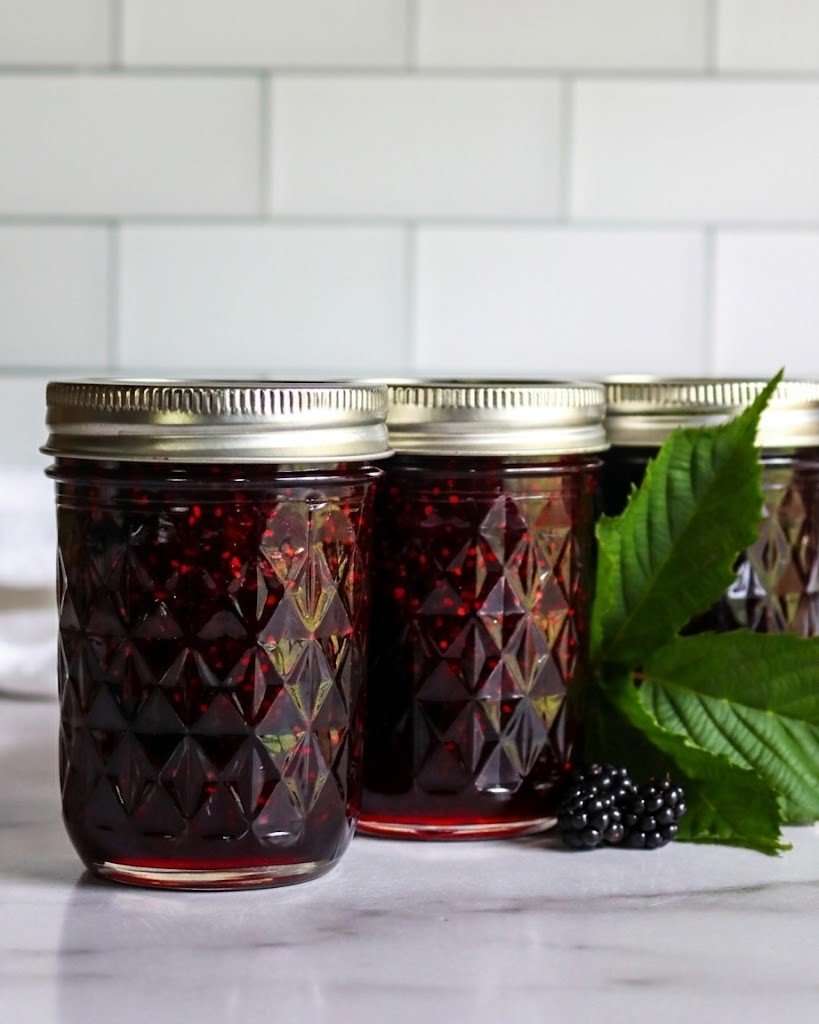
4 Half-Pint (8 oz) Mason Jars with Lids and Bands: Clean and sterilized.
-
Water-Bath Canner or Large Pot with a Rack: For processing the sealed jars.
-
Jar Lifter & Canning Funnel: For safe and clean filling.
Ingredients
-
4 cups (approx. 1.5 lbs / 700g) Fresh Blackberries (slightly under-ripe berries contain higher natural pectin)
-
3.5 cups (approx. 700g) Granulated White Sugar
-
2 tablespoons Freshly Squeezed Lemon Juice (adds acidity necessary for setting and balances sweetness)
-
1/2 teaspoon Unsalted Butter (optional: helps reduce foam formation while boiling)
Cooking Intensities & Heat Management Summary
To achieve the perfect jam set without burning the sugar, pay close attention to the heat levels required at each stage of the process:
| Stage | Heat Intensity | Purpose |
| Stage 1: Fruit Mashing & Juicing | Low Heat ($110^\circ\text{C}$ / Low Flame) | Softens fruit and draws out natural juices without burning. |
| Stage 2: Sugar Dissolution | Medium-Low Heat | Allows sugar crystals to dissolve completely before boiling. |
| Stage 3: Rapid Rolling Boil | High Heat ($104^\circ\text{C} – 105^\circ\text{C}$ / High Flame) | Evaporates water rapidly to reach the gel point. |
| Stage 4: Water-Bath Processing | High / Vigorous Boil | Creates an airtight safety seal on canning jars. |
Step-by-Step Instructions
1. Preparation and Sterilization
-
Place 2–3 small metal spoons or ceramic saucers into your freezer. You will use these later to test the jam’s consistency.
-
Wash your mason jars, lids, and rings in warm, soapy water and rinse thoroughly.
-
Submerge the jars in a water-bath canner filled with hot water and bring to a simmer. Keep them hot until ready to fill to prevent thermal shock (cracking).
2. Prepare the Blackberries
-
Gently wash the blackberries under cold running water in a colander. Remove any stems, leaves, or damaged fruit.
-
Drain thoroughly. Transfer the berries into your heavy-bottomed pot.
-
Using a potato masher, gently crush the berries over Low Heat for 3–5 minutes until they break down and release their natural juices. (Note: If you prefer a seedless or low-seed jam, pass half of the crushed mixture through a fine-mesh sieve or food mill at this point).
3. Dissolve the Sugar
-
Add the granulated sugar, fresh lemon juice, and butter (if using) into the crushed fruit.
-
Keep the heat on Medium-Low and stir constantly with a wooden spoon for 5 minutes until all sugar crystals have completely dissolved. Do not let the mixture come to a hard boil until the sugar is fully melted, as undissolved sugar can crystallize later.
4. Boil to the Gel Point (The High-Intensity Phase)
-
Increase the heat to High. Bring the mixture to a full, rolling boil—a boil that cannot be stirred down.
-
Stir frequently to prevent the sugar from catching at the bottom of the pan. Boil vigorously for roughly 15 to 25 minutes.
-
As the mixture cooks, it will transform from a loose liquid into a thick, glossy, darker red-purple syrup with larger, slower-popping bubbles.
5. Testing for the Set (Gel Test)
To verify your jam is ready without a candy thermometer:
-
Remove the pot from the heat source.
-
Pull one of your chilled spoons out of the freezer and scoop up a small droplet (~1/2 teaspoon) of jam. Let it rest on the spoon for 30 seconds.
-
Push the edge of the jam droplet gently with your fingertip. If the surface wrinkles and holds its shape, your jam is set!
-
If it remains thin and runs freely, return the pot to High Heat and boil for an additional 2–3 minutes before testing again.
(If using a candy thermometer, the jam is ready when it reaches $104^\circ\text{C} / 220^\circ\text{F}$ at sea level).
6. Canning and Preserving
-
Turn off the heat. Skim off any excess foam from the surface using a metal spoon.
-
Carefully remove the hot jars from your canner using a jar lifter and place them on a clean kitchen towel.
-
Ladle the hot jam through a canning funnel into the hot jars, leaving 1/4-inch ($0.6\text{ cm}$) of headspace at the top.
-
Wipe the rims of the jars with a clean, damp paper towel to ensure no stickiness prevents a tight seal.
-
Place the flat lid on top and screw the metal band down until it is fingertip tight (do not overtighten).
7. Water-Bath Processing
-
Lower the filled jars back into the water-bath canner. Ensure the water covers the jar tops by at least 1–2 inches.
-
Cover the pot with a lid and bring the water to a Vigorous Boil on High Heat.
-
Process for 10 minutes (adjust time for high altitude: add 5 minutes if above 3,000 feet).
-
Turn off the heat, remove the lid, and let the jars sit in the hot water for 5 minutes.
-
Carefully remove the jars and place them upright on a towel-lined countertop. Leave them undisturbed for 12 to 24 hours. You should hear a satisfying “pop” sound as the vacuum seals form!
Recipe Storage & Shelf Life
-
Unopened (Canned): Stored in a cool, dark, dry place, sealed jars will stay fresh for up to 12 to 18 months.
-
Opened: Once opened, keep stored in the refrigerator and consume within 3 to 4 weeks.
-
Uncanned (Refrigerator Jam): If you skip the water-bath canning step, allow the jars to cool at room temperature, then store directly in the fridge for up to 3 weeks or freeze for up to 6 months.
Nutritional Information
(Estimated values per 1 Tablespoon / 20g serving)
| Nutrient | Amount per Serving | % Daily Value* |
| Calories | 45 kcal | — |
| Total Fat | 0.1 g | 0% |
| Saturated Fat | 0.0 g | 0% |
| Sodium | 0 mg | 0% |
| Total Carbohydrates | 12 g | 4% |
| Dietary Fiber | 1 g | 4% |
| Total Sugars | 11 g | — |
| Added Sugars | 9 g | 18% |
| Protein | 0.2 g | 0% |
| Vitamin C | 3.5 mg | 4% |
| Calcium | 4 mg | 0% |
| Potassium | 20 mg | 0% |